



 45 / 60

— 1863: HAMBURG’S FIRST
ZOOLOGICAL GARDEN OPENS
Freiherr von Merck made another
important contribution to Hamburg’s
trade fair industry. It is thanks to his
efforts that the first Hamburg Zoo-
logical Garden opened on what is
today the site of the Planten un
Blomen park. The zoo and the ad-
joining botanical garden, which
were linked architecturally, offered
the residents of Hamburg a wide
programme of events.
— 1921: INTERNORGA PREMIERS
As a result of the opening of Carl
Hagenbeck’s zoo in 1907, the Ham-
burg Zoological Garden ran into
financial difficulties. The zoo there-
fore decided to add trade fairs to its
range of events. The very first one
marked the beginning of a success
story that continues to this day. In
1921, the Northwest German Spring
Fair was held in the Ernst Merck Hall
for the hotel, restaurant, café and
catering sector – the first INTER-
NORGA.
saw the first German Trade Show
for Sport and Utility Boats, which
attracted 65 exhibitors. The show
captured the spirit of the German
economic miracle and became
hanseboot in 1985. The Hamburg
Society of Marine Engineers show
was held for the first time in 1963,
marking the beginning of the SMM,
the world’s leading maritime trade
fair.
— FROM 1951: NEW RECORD FIGURES –
THE ERNST MERCK HALL AND THE
TRADE FAIR GROUNDS
The construction of new, modern
exhibition halls began after the Sec-
ond World War. The Ernst Merck
Hall opened in 1951. With capacity
for 6,000 spectators, it was North-
ern Germany’s biggest and most
modern event hall. As well as trade
fairs and exhibitions, it was used for
important sports events and legend-
ary concerts. To satisfy the growing
demand for space, new halls were
built on Jungiusstrasse. By 1971,
the exhibition space had grown to
52,500 square metres. In the 1980s,
this was extended to 64,000 square
metres in a total of 12 halls.
— FROM 1933: THE NAZI PERIOD –
PROPAGANDA REPLACES TRADE
SHOWS
The 1930s brought drastic changes
for the Hamburg trade fairs. Events
were now organised centrally by
the state; the fairs took on a politi-
cal character and became part of the
Nazi propaganda machine. Techni-
cally, they broke new ground with
the use of film and radio. The Bless-
ings of the Sea exhibition in 1939,
which was designed to show that
the German Reich was independ-
ent of imports from abroad, was
also held in Hamburg as an official
government event. A parade ground
was created on Jungiusstrasse in
1938. Twenty-four barracks were
built here from July 1941 to house
forced labourers.
— FROM 1950: NEW TRADE FAIRS ON
THE HOME STRAIGHT
Consumer and capital goods were
in demand. In 1950, the first special
exhibition aimed at women was
held. Five years later, this became
the DU UND DEINE WELT show.
The trade fair industry experienced
a boom in the early 1960s. 1961
✱ ✱ ✱
2008
The Neue Messe Hamburg
enhances the cityscape
✱ ✱ ✱
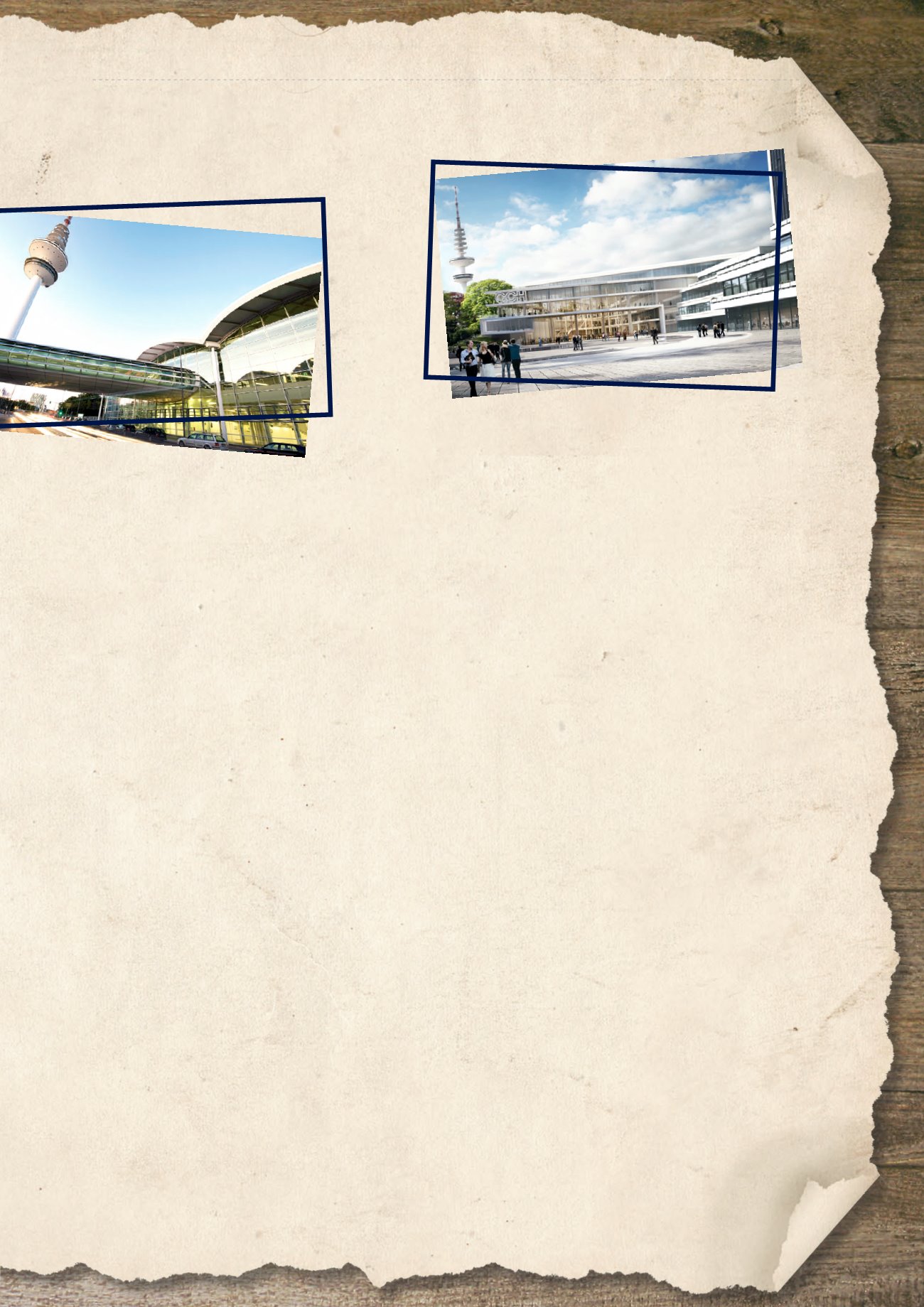
By 2019
The future – a revitalised CCH
43
Hamburg Messe und Congress | Annual Report 2014
ANNIVERSARY